
The Gap Between Training a Model and Trusting It
AI capability is advancing faster than almost any technology in embedded computing. Object detectors, signal classifiers, and vision systems that were research curiosities a few years ago now run comfortably on commodity GPUs. But raw capability is only half of the story. In aerospace, defense, and other safety-critical domains, a model that works beautifully on a workstation still faces a hard question before it can be deployed: can its behavior be predicted, bounded, and proven?
That question exposes a gap that trips up many teams. The tools that make AI easy to develop were never designed to make it safe to deploy. Frameworks for optimize flexibility, experimentation, and throughput on the desktop — not for the deterministic timing, workload isolation, and traceability that a certification authority expects. The result is a real and specific problem: the distance between what a trained model can do and what can be certified and deployed in a system where failure is not an option.
Last month, we hosted a webinar, "Bridging the AI Deployment Gap with MOSA.ic.AI", exploring how organizations can address the challenges of deploying trusted AI in mission-critical and safety-critical systems. Watch the full recording to hear insights from industry experts and learn practical approaches for moving AI from development to deployment.
Why Standard AI Inference Stacks Do Not Fit Safety-Critical Systems
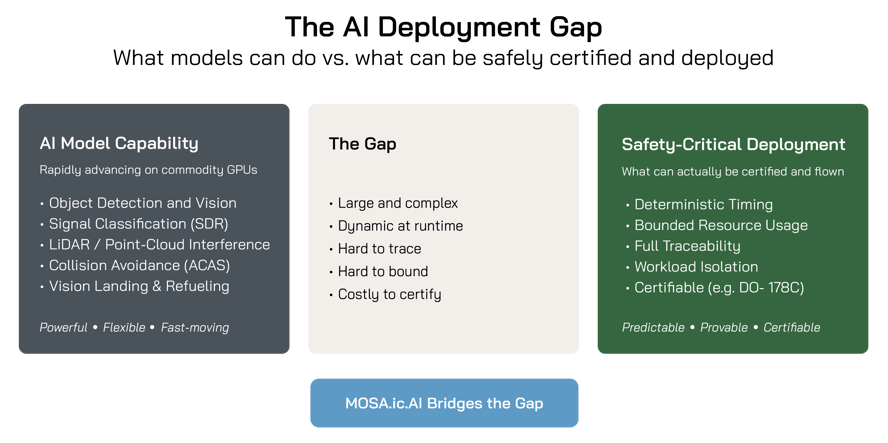
To see why the gap exists, it helps to look at what a typical AI inference stack looks like and compare it against what a safety case needs. Most inference stacks are:
- Large and complex - with deep dependency trees and heavyweight runtimes.
- Highly dynamic at runtime - making memory, scheduling, and execution decisions on the fly.
- Difficult to trace - because it is hard to follow a clear path from the model you trained to the GPU code that executes.
- Difficult to analyze - since timing and resource usage are not easily bounded.
- Costly to verify and certify - as all the above compounds into an expensive certification effort.
Each of those traits is an asset during development and a liability during deployment. Dynamic behavior that speeds up experimentation is exactly what makes worst-case timing impossible to guarantee. A rich runtime that simplifies prototyping is the same runtime that resists traceability analysis.
A safety-critical deployment wants the opposite properties: deterministic timing, bounded resource usage, full traceability from model to executed code, strict workload isolation, and a path to certification under frameworks such as DO-178C. Until an inference approach can supply those, powerful models simply cannot cross into certified systems — no matter how accurate they are.
The Principle Underneath it all
In a safety-critical system, if you cannot predict it, you cannot certify it. Determinism is not a nice-to-have — it is the entry ticket.
Where Trusted AI Actually Gets Used
This is not an abstract concern. GPU-accelerated AI is already pushing into functions where a late or unpredictable result has real consequences:
- Object detection and computer vision
- Software-defined radio and signal classification
- Airborne collision avoidance (ACAS)
- Vision-based landing systems and automated landing
- In-air refueling guidance
- LiDAR signal processing and point-cloud object detection
- Mission displays
What unites these use cases is a dual demand: they need the throughput of a GPU and the assurance of a certified real-time system at the same time. Meeting only one of those requirements is not enough.
Determinism as the Unlock: Compiling Inference Ahead of Time
The way to close the gap is to change when hard decisions are made. Instead of handing a model to a dynamic runtime that figures execution at runtime, a deterministic approach compiles the model ahead of time into a fixed, predefined set of GPU compute workloads. Nothing important is decided on the fly, because everything important has already been decided, laid out, and made inspectable.
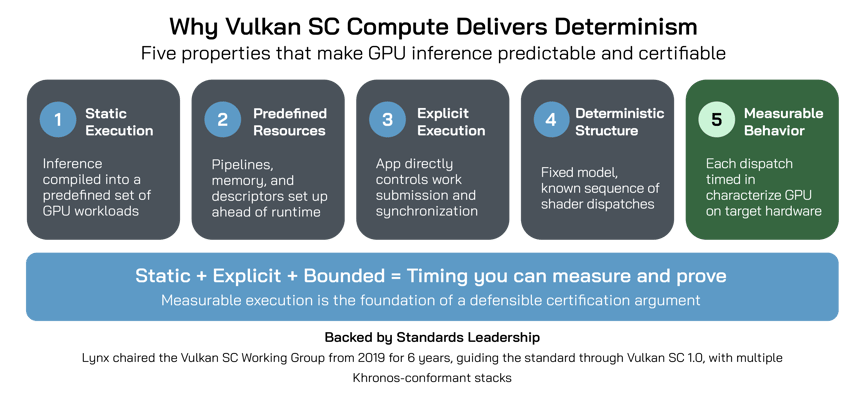
A practical foundation for this is Vulkan SC Compute — the “Safety Critical” profile of the Vulkan compute API. Vulkan SC is built to provide exactly the guarantees that dynamic stacks cannot, through five reinforcing properties:
- Static Execution- Model inference is compiled into a predefined set of GPU compute workloads rather than assembled at runtime.
- Predefined Resources- Pipelines, descriptors, memory, and execution resources are established ahead of runtime instead of being allocated dynamically.
- Explicit Execution- The application directly controls work submission and synchronization — nothing hides inside an opaque scheduler.
- Deterministic Workload Structure- A fixed model produces a known sequence of shader dispatches with known dependencies.
- Measurable Behavior- Because dispatches are fixed and explicit, each one can be individually timed to characterize GPU execution on the actual target hardware.
That fifth property is the quiet payoff. Once execution is static and explicit, timing becomes something you measure and bound rather than something you hope holds. Measurable execution is precisely what a certification argument is built on — and it only becomes possible once the first four properties are in place.
Why an Open Standard Matters Here
Choosing an open, conformance-tested standard rather than a proprietary interface is not a detail — it is a risk decision that plays out over a program’s entire lifecycle.
Vulkan SC has real institutional backing behind it. Lynx chaired the Vulkan SC Working Group from its formation in 2019 for six years, helping guide the standard through Vulkan SC 1.0, and provides multiple Khronos-conformant Vulkan SC software stacks tuned for different GPU architectures and platforms. Because Vulkan SC offers a common API across supported GPU vendors, it reduces dependence on any single proprietary compute interface. For missions expected to evolve over decades, an open standard backed by conformance testing is a far safer bet than a closed, vendor-specific stack.
A Workflow That Separates Model Development from Deployment
One of the most important design principles for deploying trusted AI is this: you should not have to change how you develop AI to deploy it safely. Model development and model deployment should be cleanly separated, so data scientists keep their existing tools and workflows while the deployment path handles determinism and certification concerns.
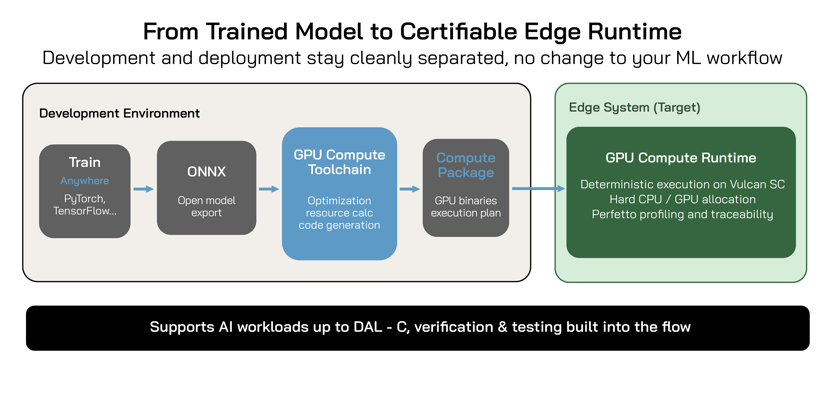
In practice, that flow looks like this:
- Train Anywhere - Use PyTorch, TensorFlow, or whatever framework your team already relies on. The guiding idea is to train anywhere and deploy deterministically.
- Export To ONNX - The trained model is exported to the open ONNX interchange format — a neutral hand-off points between development and deployment.
- Compile With A GPU Compute Toolchain - The toolchain imports the ONNX model and performs optimization, resource calculation, and GPU code generation, producing a compute package: GPU binaries plus an execution plan.
- Deploy To The Edge - A deterministic GPU compute runtime executes that package on the target, with profiling (for example, via Perfetto) available for visibility into real behavior.
In the MOSA.ic.AI implementation of this pattern, the workflow is positioned to support AI workloads up to DAL-C (a Design Assurance Level under the DO-178C avionics certification framework), with verification and testing folded into the flow rather than bolted on at the end.
Where the Complexity Lives
The model importer, optimizer, resource planner, and traceability and verification tooling all sit in the development environment. The runtime on the target stays lean and deterministic. Heavy lifting happens before deployment; what runs on the edge is small, fixed, and analyzable.
A Unified CPU + GPU Platform, Not Just an Inference Engine
Deterministic GPU inference is far more useful when it lives inside a broader platform designed for the same goals. In the LYNX MOSA.ic environment, the deterministic GPU compute runtime is one component among several built around determinism, certifiability, and open standards:
- LynxSecure — a high-assurance Type 1 separation kernel and hypervisor that delivers strong isolation, security, and performance.
- LynxOS-178 — a deterministic, safety-focused real-time operating system for aerospace and defense, compatible with industry standards such as POSIX, FACE™, and ARINC 653.
- LynxElement — a lightweight unikernel on a safety-certified RTOS foundation, designed to run single-function applications efficiently and simplify integration and certification.
- GPU Compute Runtime — the deterministic engine for real-time execution of compute workloads, with Vulkan SC interoperability and profiling.
Mixed-Criticality: Safety and Non-Safety on One Box
A defining capability of this kind of platform is mixed-criticality execution. A Type 1 hypervisor with hard CPU/GPU allocation and partition isolation can run workloads at different assurance levels on the same hardware without letting them interfere.
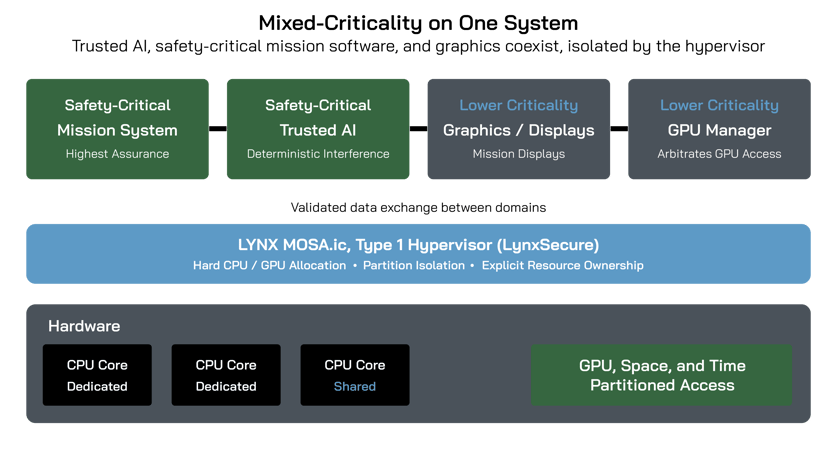
Two operating modes illustrate the range:
- Full safety-critical mode - where a single safety-critical GPU path is governed entirely by the platform.
- Mixed-criticality mode - where a safety-critical mission system, a trusted AI partition, and lower-criticality graphics coexist — each partition receiving hard, dedicated CPU and GPU allocation, with validated data exchange between domains.
The practical consequence is significant. Certified inference and a less-critical display workload can share a single system, but they cannot step on one another: resource ownership is explicit, and isolation is enforced by the hypervisor. That is what makes it realistic to consolidate multiple functions onto one SWaP-constrained (Size, Weight, and Power) edge system instead of stacking separate boxes — a major win for platforms where every watt and gram counts.
Inside the Model-to-GPU Compiler
The determinism guarantees come from the compiler that turns a trained model into a runnable package. It helps to understand its stages, because each one produces an artifact you can inspect — which is exactly what traceability requires.
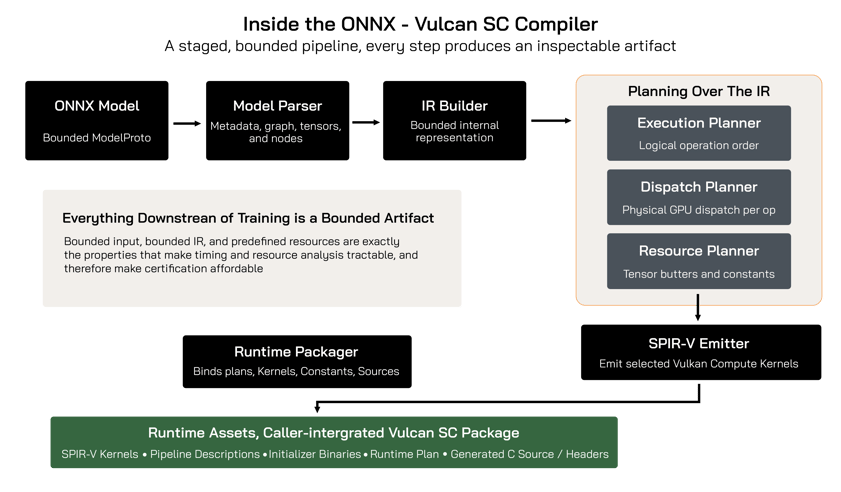
A representative ONNX-to-Vulkan SC compilation pipeline works like this:
- Read The Model - Ingest a bounded ModelProto file. The bounded part matters: bounded inputs are what make later analysis tractable.
- Parse - Decode the model’s metadata, compute graph, tensors, and nodes.
- Build An Intermediate Representation - Construct and optimize a bounded internal representation (IR) of the model.
- Plan Over The IR - Three planners operate on that representation: an execution planner establishes logical operation order; a dispatch planner selects and optimizes a concrete physical GPU dispatch for each operation; and a resource planner defines tensor buffers and constant payloads.
- Emit Kernels - A SPIR-V emitter produces the selected Vulkan compute kernels.
- Package - A runtime packager binds the plans, kernels, constants, and runtime sources into a caller-integrated Vulkan SC package.
The output — the runtime assets — includes SPIR-V kernels, offline pipeline descriptions, initializer binaries, the model runtime plan, and generated Vulkan SC command-recorder C source and headers.
Why "Bounded" Keeps Coming Up
Bounded input, bounded IR, predefined resources — that is not incidental. Bounded and predefined are the exact properties that make timing and resource analysis tractable, and tractable analysis is what makes certification affordable rather than prohibitive. Everything downstream of training becomes an inspectable artifact rather than a black box.
Turning Architecture into Evidence
Determinism is only convincing if you can show it. Three kinds of visibility turn the architecture from a claim into evidence:
- A Diagnostic Model View - makes optimization and transformation steps visible, so engineers can see how a model was reshaped on its way to GPU code instead of trusting a black box.
- A Live Inference Demo - for instance, object detection — proves that a generated model runs end-to-end, from compilation to real-time execution on Vulkan SC Compute.
- A GPU Execution Trace - provides a timeline (via a tool like Perfetto) that measures the generated model’s execution dispatch by dispatch.
That final trace is the whole argument made concrete. Because execution is static and explicit, it can be measured — and measurable execution is the foundation of a defensible timing and certification case.
Key Takeaways
A few durable lessons for anyone deploying AI into constrained, safety-critical systems:
- The Deployment Gap Is Real And Specific - The problem is not model accuracy; it is that the runtimes carrying models are dynamic, opaque, and hard to certify.
- Determinism is Unlocked - Compiling inference into a fixed, predefined set of GPU workloads converts “hope it’s fast enough” into “measure that it is.”
- Keep Development And Deployment Separately - Train your existing framework, export to ONNX, and let a compute toolchain produce a certifiable package — no need to rebuild your ML workflow.
- Open Standards Reduce Long-Term Risk - Vulkan SC and ONNX provide hardware portability and vendor independence that matter across a program’s full lifecycle.
- Mixed Criticality Makes Consolidation Practical - Hard CPU/GPU partitioning lets trusted AI, safety-critical mission software, and lower-criticality graphics share one SWaP-constrained system safely.
- Everything Becomes An Inspectable Artifact - Bounded IR, generated SPIR-V, execution plans, and profiling traces supply the traceability of a safety case of demand.
The throughput of modern AI and the assurance of certified real-time systems no longer must be mutually exclusive. With ahead-of-time compilation, a deterministic runtime, and an open, mixed-criticality platform, trained models can move from the workstation to the edge — and be trusted when they get there.
See how MOSA.ic.AI helps teams deploy deterministic, certifiable AI at the edge—with ahead-of-time compilation, predictable execution, and mixed-criticality isolation.
Learn more: LYNX MOSA.ic.AI Datasheet
Watch: Bridging the AI Deployment Gap with MOSA.ic.AI: Your trained model, deployed for Deterministic Inference in constrained, safety-critical environments