
Parts 1 and 2 traced AFA 2026 from its themes down to the software properties they require. This post closes the loop: for each thing the warfighters asked for, here is how the Lynx platform supports it today.
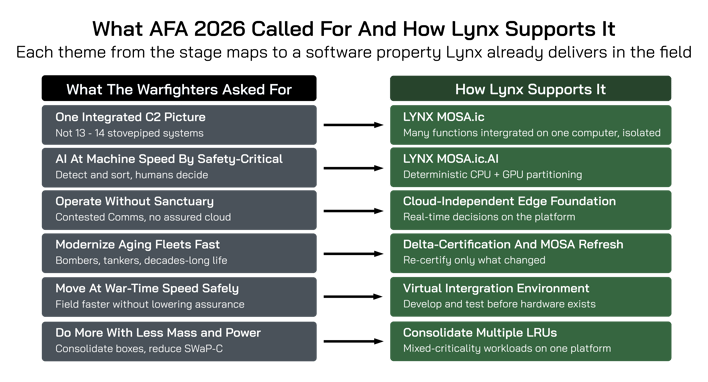
Unified C2 → Many Functions On One Computer, Isolated
The call to collapse many stovepipe C2 systems into one integrated picture is, at the software level, the mixed-criticality integration problem — exactly what LYNX MOSA.ic is built for. Its separation-kernel foundation lets multiple operating systems and applications run side by side on a single multicore computer with strong isolation and predictable resource allocation. Many functions, one platform, without shared fate.
AI At Machine Speed → Deterministic CPU + GPU Partitioning
Running AI beside safety-critical work — detecting and sorting threats at machine speed while a human decides — is precisely the problem LYNX MOSA.ic.AI addresses. It extends the deterministic infrastructure model across CPU and GPU domains, so accelerated and AI workloads coexist with real-time and safety-critical applications without interfering with their timing or integrity.
No Sanctuary → A Cloud-Independent Edge Foundation
When communications are contested and the cloud cannot be assumed, decisions must happen on the platform. Lynx is built for exactly this: a deterministic, real-time foundation for edge computing that makes cloud-independent decision-making dependable under load — the software premise behind operating without sanctuary.
Refresh Under Pressure → Delta-Certification And MOSA Refresh
For fleets that will fly for decades, Lynx’s modular architecture is designed so that a change re-certifies only what changed, not the whole system. That delta-certification approach is what makes it affordable to keep inserting new sensors, weapons, and compute into long-lived platforms — the modernization-under-pressure theme, answered at the architecture level.
War-Time Speed → Develop And Test Before The Hardware Exists
The push to field faster without lowering the assurance bar is where the Lynx Virtual Integration Environment earns its place: teams develop and validate software before target hardware is available, taking risk and time out of the schedule while keeping the certification story intact. It is how a program can move out now and still be safe.
Already In The Field
This is not theoretical. LYNX MOSA.ic was selected by Bell Textron and Lockheed Martin to help power mission-system software on the U.S. Army’s Future Long Range Assault Aircraft — the MV-75 Cheyenne II — a program built around a MOSA open-architecture digital backbone and designed for refreshable integration across a decades-long service life. The properties AFA 2026 asked for are already being delivered on an Army flagship.
The conference described the mission. A safe, secure, modular software foundation is how it gets built — and kept current — for the decades ahead.
The warfighters on stage were clear about what they need: integrate what is stovepipe, put AI to work at machine speed without giving up human judgment, operate where there is no sanctuary, and refresh aging platforms faster than the threat evolves — all without lowering the bar on safety and security. That is the problem Lynx exists to solve.
Turning these capabilities into an operational architecture takes planning. Talk with Lynx about your platform’s integration, AI deployment, or modernization needs—and identify a practical path forward.
Discuss Your Architecture with Lynx