
This year’s Air, Space & Cyber Conference took place September 14–16, 2026, at National Harbor, MD. Themes are drawn from keynote and panel remarks across all three days; this series intentionally stays on the technical and architectural. 2026 Air, Space & Cyber Conference
Three days of keynotes and panels covered a lot of ground — homeland defense, long-range strike, space, acquisition reform. But underneath the individual programs, the same handful of technical themes kept surfacing. Here are the five that matter most for anyone building the computing that these missions run on.
1. No More Sanctuary
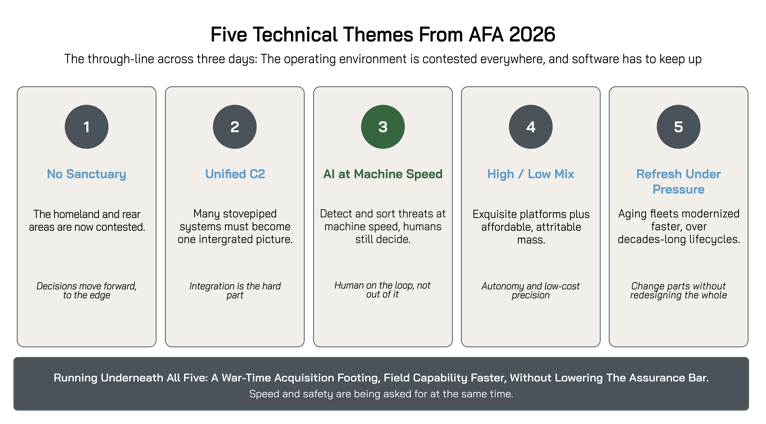
The organizing idea of the whole event was that the homeland and rear areas can no longer be treated as safe. Senior leaders described a future fight without uncontested access, secure rear areas, or assured sustainment, and pointed to recent operations in which air bases themselves were under attack. The Air Force elevated point defense from an afterthought to a core function, including a new career field dedicated to it. The technical consequence is clear: when you cannot assume a safe rear or a reliable link home, more of the sensing, deciding, and acting must happen forward — at the edge, in real time.
2. Integration And Unified C2 Are The Hard Part
The most striking admission came from the homeland missile-defense discussion: the challenge is less about any single sensor or interceptor and more about integration. Leaders described the need to collapse many separate command-and-control systems into a single integrated picture, so an operator can see everything from a small drone to a ballistic missile on one system. One leader framed it plainly — this is an organizational and integration problem more than a technology problem. That is a software-architecture statement, and it recurred across every domain.
3. AI At Machine Speed, With A Human On The Loop
A second consistent theme: the volume and speed of incoming threats — waves and swarms of drones and missiles — exceed human reaction time, so AI must help detect, classify, and prioritize at machine speed. Just as consistently, leaders were careful to say this is not full automation: AI recognizes the threat and the target for a human to decide. The recurring phrase “drowning in data, starved for information” captured the real problem — not a shortage of data, but the job of turning it into a decision fast enough to matter.
4. A High / Low Mix: Exquisite Platforms And Affordable Mass
Speakers repeatedly described a future force that pairs a small number of exquisite platforms with large numbers of affordable, low-cost / cost-effective systems — collaborative autonomous aircraft, and a shift toward lower-cost precision at scale. Lessons cited from current conflicts pointed to how quickly cheap, software-defined autonomy is changing the cost of each exchange. The computing implication is significant: autonomy and low-cost mass both depend on capable, trustworthy software running on constrained, inexpensive hardware.
5. Refresh Under Pressure
Finally, a great deal of the conference was about modernizing platforms that will serve for decades — bombers and tankers, some of them generations old, being upgraded with new engines, radars, weapons, and communications. Leaders were candid about the tension between near-term readiness and longer-term modernization. The unifying need is the ability to refresh capability — new sensors, new weapons, new compute — without redesigning the entire platform each time.
The Thread Running Underneath: Speed Without Lowering The Bar
Across all five themes ran a demand for a war-time acquisition footing — field capability faster, pick winners earlier, share risk with industry. The hard part, rarely stated but always implied, is that none of the safety, security, or assurance expectations go away because the schedule compressed. Speed and safety are being asked for at the same time. The rest of this series looks at what that requires of the software — and how it gets built.