
Why Compute is an Aircraft-Level Decision
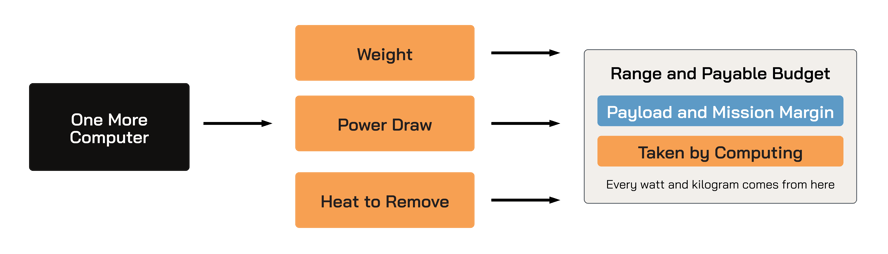
In an electric aircraft, computing connects directly to range and payload. Each onboard computer draws power, adds weight, and produces heat that the thermal system must remove. All three come out of payload and mission margin, so consolidating workloads onto multi-core SoCs is a decision about the whole aircraft, not an IT tidy-up.
There is a catch. Consolidation only works if functions with different safety needs stay isolated from one another. The goal is not simply fewer computers. It is more workloads on shared hardware, with the boundaries, timing and evidence that flight-critical functions demand intact.
Eight Workloads, Very Different Assurance Needs
A modern eVTOL may need to compute flight control and envelope protection, displays and HMI, battery and power monitoring, cyber services, sensor perception, AI-assisted awareness, connectivity, and software updates and logging. Flight control sits at the highest assurance level. Displays, battery monitoring, and cyber services also carry high assurance needs. Perception, AI-assisted awareness and connectivity often sit lower, and some depend on how the function is used.
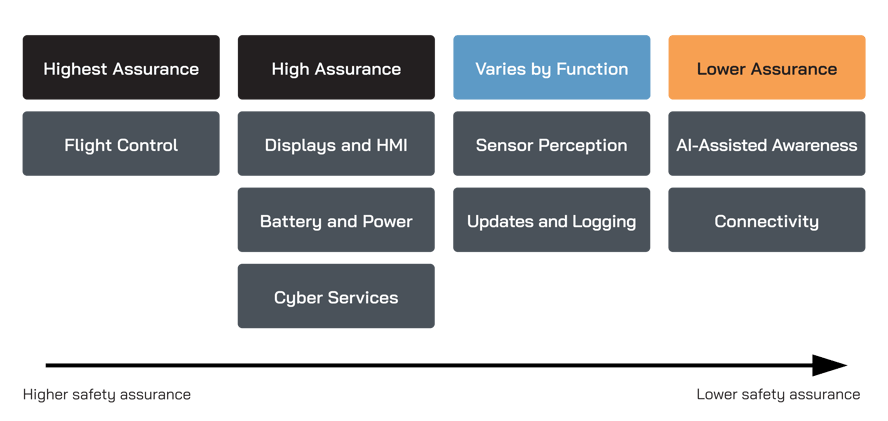
The same capability can carry different implications depending on its role, and today many of these workloads still arrive as separate boxes. A good first question for any design team: how many separate computers does the aircraft carry?
Buyers Ask for a Package, Not an Operating System
Across the supplier requests we see in the market, a composite rather than any one customer, buyers evaluate a connected set of capabilities:
-
Assurance: DO-178C DAL A, ARINC 653 and qualified tools.
-
Security: A DO-326A approach and hardware security module support.
-
Partitioning: Hypervisor or separation kernel tooling, with DO-331 for model-based development.
-
Silicon: Board support for several SoC families, including multi-core, GPU and FPGA.
-
Middleware, Graphics and AI: Messaging, avionics buses, Vulkan and OpenGL, and AI/ML frameworks.
-
Lifecycle and Commercial Terms: Updates, logging, certification support and licensing that survives production.
Silicon deserves special attention. OEMs often evaluate more than one SoC family, so support for their choice, rather than the vendor’s, can decide a selection.
One Platform, Many Criticalities
The architecture that ties these needs together is mixed criticality: several workloads on one platform, with separation matched to each one’s needs. Every workload runs in its own partition. A separation kernel and hypervisor enforces the boundaries, giving each partition defined memory and time budgets and allowing communication only through controlled channels. Beneath it sits a multi-core SoC with GPU and I/O.
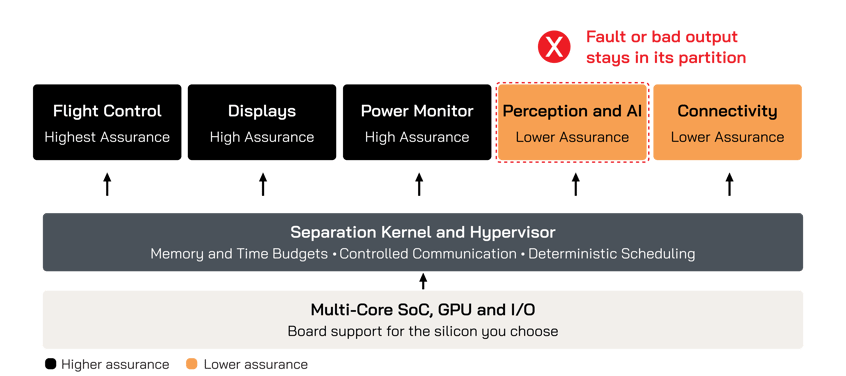
A fault or bad output in a lower-assurance partition stays inside that partition.
That is the key idea: containment. If a lower-assurance perception or AI workload faults or produces a bad output, the design keeps the event inside its partition and its permitted interfaces, while flight control retains its own resources and communication paths.
Shared hardware adds one more concern: interference. Partitions may share cores, caches, and memory, so timing must be understood and managed. Deterministic scheduling and resource budgets are part of making the platform predictable, certifiable, and upgradeable.
Isolation Protects the Certification Evidence
Three points matter when you translate this architecture into certification terms:
-
Fault Containment: Partitioning provides an argument for keeping a fault in a lower-assurance function from affecting a flight-critical one.
-
Change Impact: AI models and display applications will change over the life of the aircraft. Clear boundaries can help define which evidence must be revisited, when the certification plan supports that approach.
-
Multi-Core Timing: Shared resources create interference that belongs in the assurance case.
Isolation does not automatically simplify certification or remove the need for evidence. The OEM and its certification authority agree on the credit the architecture receives in each program’s plan.
One Platform, Several Regulatory Paths
Global programs may have to work through more than one authority. The FAA’s path is performance-based, built around Part 23, with issue papers and consensus standards as means of compliance. EASA has a Special Condition for VTOL with published proposed means of compliance. CAAC has moved quickly on eVTOL, including autonomous cargo and passenger programs, while still expecting system safety analysis and high assurance for critical systems.
The common thread is system safety, DO-178C-class software evidence, and DO-326A security, with DO-331 where models generate code. These standards contribute to the assurance approach but do not replace the full safety argument. The compute platform should adapt across programs even when the certification path differs.
Introduce AI in Three Phases
AI adoption is a sequence, not a leap to full autonomy.
-
Now: Richer displays and sensor-aided awareness for piloted operations, using terrain, video and LiDAR, kept apart from flight control.
-
Next: Inference running beside flight-critical code in its own partition, watched by a high-assurance run-time monitor. Battery and power anomaly prediction is a candidate, but it depends on suitable models, data, and simulation.
-
Later: Autonomy assurance for reduced crew and remote operations. Conventional DAL A assumes deterministic requirements, while autonomy must choose the safest action under uncertain inputs, so it needs scenario-based validation and system-level evidence, not just process compliance.
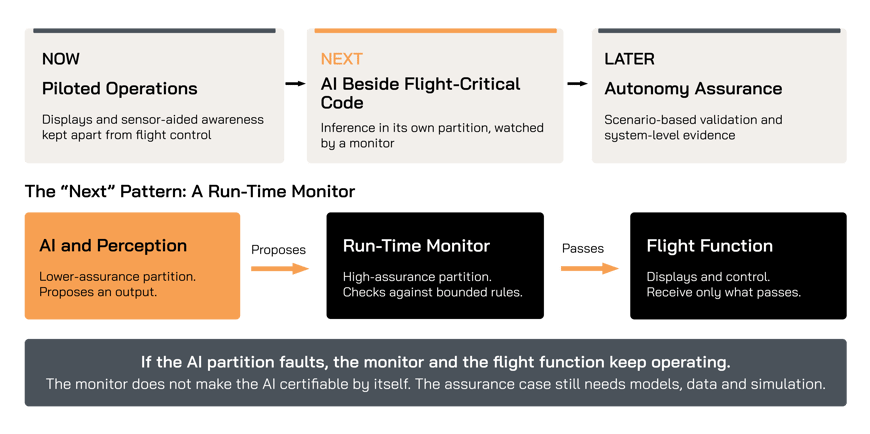
The run-time monitor pattern is worth designing in early. The AI or perception function runs in a lower-assurance partition and proposes an output. A small, deterministic monitor checks that proposal against bounded rules, and only what passes reaches the display or control function. If the AI partition faults, the monitor and flight function keep operating within their own boundaries. The monitor does not make the AI certifiable by itself. The assurance case still depends on requirements, models, data, simulation, integration, and agreement with the authority.
Design for the Life of the Fleet
The software lifecycle continues after first flight. Teams will need secure software loading, logging and health data, and security that holds for the life of the fleet. Partitioning helps manage changes to individual functions within the program’s approved process, and secure loading, key handling and hardware security module support belong in the onboard platform from the start.
Questions to Ask Before You Consolidate
-
How many separate computers does the design carry today, and which workloads could share one?
-
How is each workload’s assurance level set, and where is that documented?
-
How are memory, time and interference budgeted across partitions?
-
What evidence must be revisited when an AI model or display application changes?
-
Which silicon will you choose, and does the platform support it?
-
How will software be updated and secured over the life of the fleet?
Where Lynx Fits
LYNX MOSA.ic.AI helps eVTOL developers host flight-critical, display, sensor and AI workloads together on a certifiable compute platform, so new capability can be introduced with the safety case in view. Start with an architecture assessment that maps your workloads to partitions and assurance levels, board bring-up and early integration on the SoC you are evaluating, or a working session on your block diagram.