
LYNX MOSA.ic 2026.06 brings full ARINC 653 supports together on a modern separation-kernel architecture, engineered for scalability, certification efficiency, and deterministic performance across LynxElement®, LynxOS-178, and LynxSecure®.
For teams building avionics and other mission-critical edge systems, there is always a tension between the need to move faster and the need to prove to a certification authority, a prime, or a program office, that the system behaves exactly as specified, every time. The MOSA.ic 2026.06 release is built around closing that gap.
ARINC 653 itself is well established, the difference is in how it's delivered. MOSA.ic 2026.06 integrates ARINC 653 partition synchronization directly into the LynxSecure separation-kernel virtualization stack: an architecture built for scalability, certification efficiency, and deterministic performance.
The release also modernizes how engineers debug LynxElement, tightens timing determinism, and expands hardware consolidation on x86, all reinforcing the same goal: reduce certification scope and risk while giving builders more control over the platform.
Here's what's new, and why it matters.
A Modern Architecture for ARINC 653
With 2026.06, MOSA.ic brings ARINC 653 capabilities together on a modern foundation. Rather than layering ARINC 653 onto a conventional RTOS stack, MOSA.ic pairs the well-understood, certifiable model for time and space partitioning directly with the isolation guarantees of the LynxSecure separation kernel hypervisor, a modular architecture designed to scale from a single partition to complex mixed-criticality systems without re-architecting.
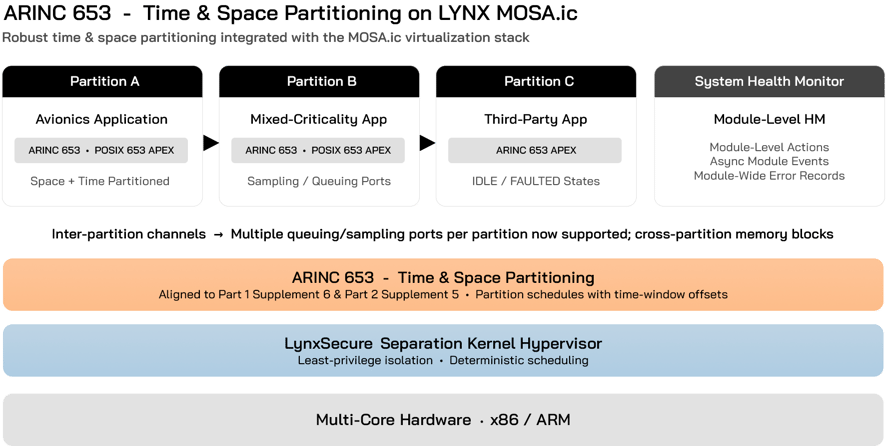
Figure 1: ARINC 653 partitioning on MOSA.ic - Partitions isolated in time and space over the LynxSecure kernel hypervisor
Practical scalability improves as well. A limitation in the ARINC 653 ISCC configuration that prevented multiple queuing ports on the same channel from living in a single partition has been removed, and configurations now support multiple destination ports and a source port on the same channel within the same partition.
Intra-partition communication, process, time, mutex, health-monitoring, and file-system services are now aligned to ARINC 653 Part 1 Supplement 6 and Part 2 Supplement 5. A dedicated ARINC 653 Conformance Document details each supported API, so certification and integration teams can map platform behavior to the standard without guesswork.
Why it Matters
Delivering ARINC 653 on a separation-kernel foundation means a cleaner certification story, less custom glue code, and the headroom to scale and consolidate as programs grow, not just a box checked, but a foundation to build on for the life of the program.
A Modern Developer Experience: VS Code and Standard GDB
Engineers can now debug LynxElement applications running on QEMU directly from Visual Studio Code using GDB instead of Lynx’s older, proprietary SKDB agent. The release ships with VS Code configuration settings and a Dev Container as a starting point that teams can customize for their own workflows.
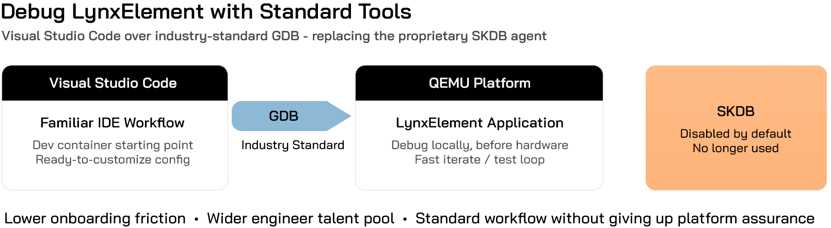
Figure 2: Debug LynxElement in QEMU from Visual Studio Code over standard GDB
Why it Matters
Standard Tools lower onboarding friction, widen the pool of engineers who can be protective from day one, and let safety-critical teams work the way the rest of the software world already does. QEMU enables rapid development before target hardware is available.
Sharper Determinism and Tighter Consolidation
Determinism is the foundation of every certification argument, and 2026.06 strengthens it at the source. Monotonic time now starts at timebase 0 and uses 128-bit arithmetic, eliminating the need for constant monotonic clock mark adjustments. Just as important, monotonic timestamps are now aligned across all guest VMs and with LSK. LynxSecure exposes the monotonic time multiplier and shift parameters in the read-only page, allowing subjects to calculate current monotonic time without the overhead of a hypercall. The release also adds support for a configurable fixed idle minor frame in the HCV configuration.
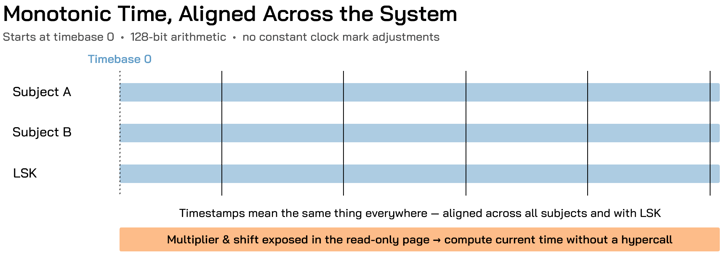
Figure 3: Monotonic time starts at timebase 0 and stays aligned across all guest VMs and LSK, with time computable from the read-only page.
On the consolidation side, LynxSecure on x86 platforms now supports sharing a single physical PCI device among multiple guest VMs.
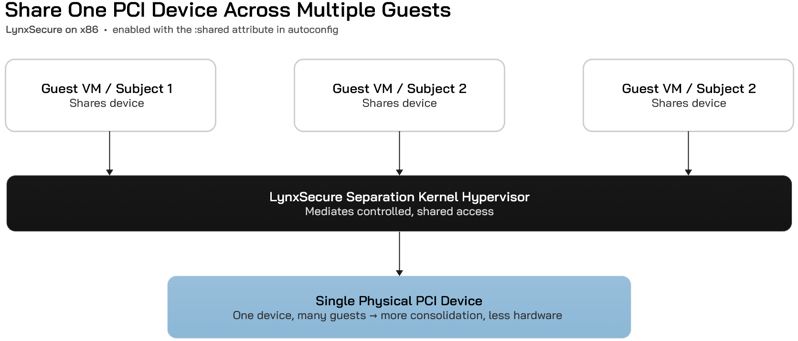
Figure 4: One physical PCI device shared across multiple guest VMs on x86, folding more functionality onto a single mission computer.
Why it Matters
Aligned, low-overhead timekeeping simplifies reasoning about system behavior, which is exactly what auditors and integrators want. And PCI device sharing lets architects fold more functionality onto a single multi-core mission computer, advancing the size, weight, power, and cost (SWaP-C) reductions that drive modern platform designs.
Looking Ahead: Expanded ARINC 653
The 2026.06 release also provides a significant expansion of ARINC 653 capabilities:
- Broader coverage of the ARINC 653 standard in XML configuration
- Partition schedules with time-window offsets
- Cross-partition memory via Memory Blocks
- Module-level health monitoring, including module-level actions and asynchronous module event handling
- System Health Monitoring partition configuration for module-level error handling and module-wide error reporting
- Partition IDLE mode and FAULTED process-state handling
Why it Matters
MOSA.ic exists to help engineers build, certify, and deploy mission-critical systems on a modular, MOSA-aligned architecture—reducing certification scope, accelerating deployment, and sustaining platforms across the 10- to 30-year lifecycles these programs demand. The 2026.06 release advances all three: a modern ARINC 653 architecture built for conformance and scale, standard tooling for velocity, and stronger determinism and consolidation for the systems themselves.
The LYNX MOSA.ic 2026.06 release is available now.
Ready to see what it means for your program? Talk to the Lynx team to walk through the release, the migration path, and how a complete ARINC 653 implementation fits your certification strategy.
LYNX MOSA.ic, LynxSecure, LynxElement, and LynxOS-178 are trademarks of Lynx. Other brand or product names are trademarks of their respective holders.