
The global security environment is evolving at a pace that is forcing a rethinking of how modern defense systems are designed.
Missile defense sits at the center of this transformation. Emerging threats such as hypersonic weapons, drone swarms, and increasingly sophisticated electronic warfare capabilities are compressing operational timelines and dramatically increasing the complexity of defensive systems. Sensors generate vast streams of data; AI-assisted analytics are becoming essential to decision-making, and multi-domain command-and-control systems must operate seamlessly across distributed environments.
Industry analysis increasingly reflects this shift. A recent Aerospace & Defense report from Morgan Stanley describes the geopolitical environment as moving away from rare “black swan” events toward what analysts call a “fat-tail” risk landscape, where extreme geopolitical scenarios occur more frequently and persist longer than previously expected. In this environment, defense modernization is less cyclical and more structural, driven by the need to maintain technological advantage and operational readiness in an increasingly contested world.
Market Reality
-
Persistent multi-theater conflict
- NATO & allied mobilization
- Missile & air defense urgency
- AI + autonomy extending platforms
Technical Implications
-
Deterministic edge compute
- Mixed-criticality consolidation
- Safe AI integration
- Real-time sensor fusion
- GPU-accelerated visualization
Lynx Strategic Alignment
-
MOSA.ic: Separation & certification
- CoreSuite: Deterministic GPU stack
- Safe AI: Secure coexistence model
- Services: Migration & scaling support
For missile defense programs, this evolving threat landscape places new demands not only on sensors, interceptors, and command systems, but also on the computing architectures that tie these elements together.
The mission computer, historically treated as infrastructure, is becoming a central enabler of operational capability.
The Growing Complexity of Missile Defense Systems
Modern missile defense systems rely on a tightly integrated chain of technologies that must operate with extremely high levels of reliability and determinism. Radar systems detect potential threats and generate raw tracking data. Sensor fusion algorithms correlate multiple data streams to produce a coherent operational picture. Command-and-control systems evaluate threats and determine appropriate responses. Interceptor guidance and fire control systems then execute defensive actions within extremely tight time windows.
In earlier generations of defense platforms, these capabilities were often implemented as separate subsystems. Dedicated hardware boxes would run individual functions such as flight control, mission management, sensor processing, or operator interfaces. These systems communicated with each other through well-defined interfaces, forming what was commonly referred to as a federated architecture.
While effective for many years, this approach is increasingly difficult to sustain in today’s operational environment. Federated systems introduce significant integration complexity, increase system size and power requirements, and create challenges when introducing new technologies such as AI-driven analytics or advanced visualization capabilities.
As the number of sensors and data sources grows, so does the need for faster and more integrated processing.
The result is a clear shift across defense programs toward consolidated mission computing architectures.
The Shift Toward Consolidated Mission Computing
Rather than distributing workloads across multiple hardware platforms, modern defense systems are increasingly designed to run multiple operational functions on a single mission computer. Consolidation allows data to move more efficiently between subsystems, reduces hardware complexity, and lowers the size, weight, power, and cost (SWaP-C) of deployed platforms.
More importantly, consolidated architectures enable systems to evolve more rapidly. When new algorithms, sensors, or software capabilities are introduced, they can often be integrated through software updates rather than requiring entirely new hardware subsystems.
However, consolidation introduces an architectural challenge that is particularly important for mission-critical environments. Different workloads operating within the same computing system must remain strictly isolated from each other. Safety-critical control systems, mission applications, sensor processing pipelines, and AI workloads all have different requirements for determinism, security, and certification. If these workloads interfere with each other, the consequences could affect system reliability or safety certification.
This challenge has led to increasing adoption of mixed-criticality computing architectures, where multiple classes of software workloads coexist on the same hardware platform while remaining strictly isolated.
Mixed-Criticality Systems at the Mission-Critical Edge
Missile defense systems must support a diverse set of software workloads that operate simultaneously but under very different constraints. Safety-critical control software must meet strict certification standards and execute deterministically. Mission applications must process operational data and interact with command networks. Sensor processing pipelines must manage high-bandwidth radar and ISR data streams. AI workloads increasingly assist with threat identification, sensor fusion, and decision support.
These workloads cannot simply be deployed together in a conventional computing environment. Instead, they require an architectural model that allows them to operate independently while sharing common hardware resources.
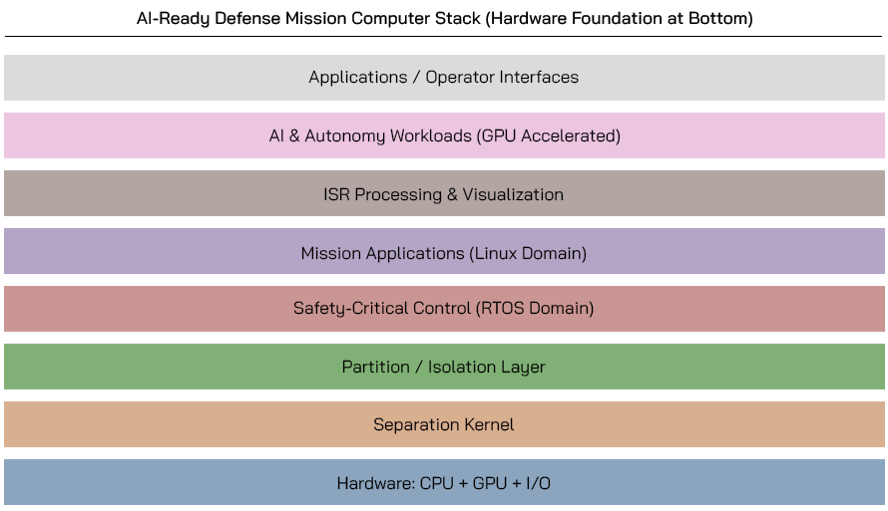 A layered mission computer architecture where hardware and a separation kernel provide the trusted compute foundation for deterministic partitioning, enabling safety-critical control, mission applications, ISR processing, and GPU-accelerated AI workloads to coexist safely
This is where separation kernel architectures and deterministic partitioning technologies become essential. By enforcing strict boundaries between software domains, separation architectures allow safety-critical real-time operating systems, general-purpose operating systems such as Linux, and GPU-accelerated AI environments to run simultaneously on the same hardware platform.
Each workload executes within its own protected partition, preventing interference with other domains while maintaining deterministic system behavior. This architectural model makes it possible to consolidate multiple functions onto a single mission computer without compromising safety or security.
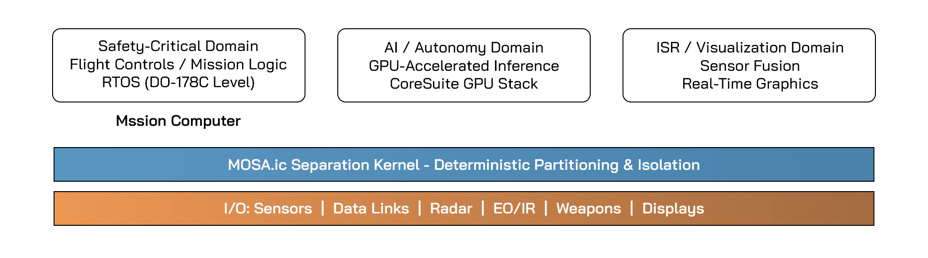
A separation-kernel architecture allows safety-critical RTOS workloads, Linux mission applications, and GPU-accelerated AI analytics to run simultaneously while maintaining deterministic isolation.
AI and GPU Acceleration in Missile Defense Systems
Artificial intelligence is rapidly becoming an important tool in modern defense systems. AI-enabled algorithms can assist in identifying threats more quickly, filtering sensor noise, improving target tracking accuracy, and supporting autonomous or semi-autonomous defensive responses.
These workloads are computationally intensive and often benefit from GPU acceleration, which enables parallel processing of large data sets. In missile defense systems, GPUs can significantly enhance capabilities such as sensor fusion, real-time visualization, and AI-driven analytics.
However, integrating GPU-accelerated workloads into mission-critical environments requires careful architectural design. AI applications must never compromise the determinism of safety-critical control systems. This means GPU processing must operate within controlled, safety-partitioned environments where compute resources are carefully managed and isolated. When implemented correctly, this approach enables defense platforms to leverage the power of modern AI technologies while maintaining the strict operational assurance required for mission-critical systems.
Modular Architectures and Long-Term Platform Sustainability
Another key driver shaping mission computer design is the increasing adoption of Modular Open Systems Architecture (MOSA) principles across defense programs.
MOSA promotes modularity, standard interfaces, and vendor-independent integration models. These principles enable defense platforms to incorporate new technologies more easily over time while reducing long-term program risk. By combining MOSA principles with deterministic partitioning and separation-kernel virtualization, mission computer architectures can provide a stable computing foundation that remains adaptable throughout a platform’s lifecycle.
This capability is increasingly important for long-lived defense systems, where computing infrastructure must evolve alongside new sensors, algorithms, and operational requirements.
A New Foundation for Mission-Critical Edge Systems
The convergence of these trends is reshaping how modern defense platforms are built.
Mission computers are evolving into secure, modular edge computing platforms capable of supporting mixed-criticality workloads, GPU acceleration, and AI-driven analytics. Rather than serving as simple computing infrastructure, these systems now act as the operational backbone connecting sensors, decision systems, and defensive actions. In environments such as missile defense, where decisions must be made in milliseconds and system reliability is paramount, computing architecture becomes a strategic capability.
Explore the Architecture in More Detail
For organizations exploring the technical foundations behind these architectures, we have prepared several deeper technical resources.
Reference Mission Computer Architecture (AI-Ready, Mixed-Criticality)
Explore how a modern mission computer can support safety-critical RTOS workloads, Linux mission applications, and GPU-accelerated AI processing on a single hardware platform.
Download the Reference Mission Computer Architecture Guide
Legacy Consolidation: Commercial RTOS like VxWorks + Linux + AI on One Mission Computer
Learn how separation architectures enable traditionally federated systems to be consolidated while preserving safety, certification boundaries, and operational determinism.
Read the Legacy Consolidation Technical Brief
Missile Defense Modernization and Edge Architecture
Discover how deterministic edge computing supports real-time sensor fusion, AI-enabled threat analysis, and track-to-intercept decision loops in next-generation missile defense systems.
Download the Missile Defense Modernization and Edge Architecture Guide
The Bottom Line
The operational environment for defense systems is becoming more complex and more demanding. Emerging threats, multi-domain operations, and AI-driven analytics are reshaping how platforms must process information and respond to rapidly evolving situations. In this environment, the computing architecture supporting mission-critical systems is no longer simply an implementation detail. It is a foundational element that determines how effectively a platform can evolve, integrate new technologies, and maintain operational assurance.
AI-ready mission computers at the edge will play a central role in enabling the next generation of missile defense and mission-critical defense systems.
Schedule a meeting with our team to determine how we can assist you in your mission-critical projects.