- Home
- Case Studies
- One Airframe, Three Missions: Mission Computing for a Multi-Role eVTOL
One Airframe, Three Missions: Mission Computing for a Multi-Role eVTOL
How a leading developer of electric vertical take-off and landing (eVTOL) aircraft is architecting central and zonal mission computing to run safety-critical and robotics software side by side
Key Capabilities
GitLab CI/CD
DOORS
VectorCAST
AdaCore
SaFe Agile

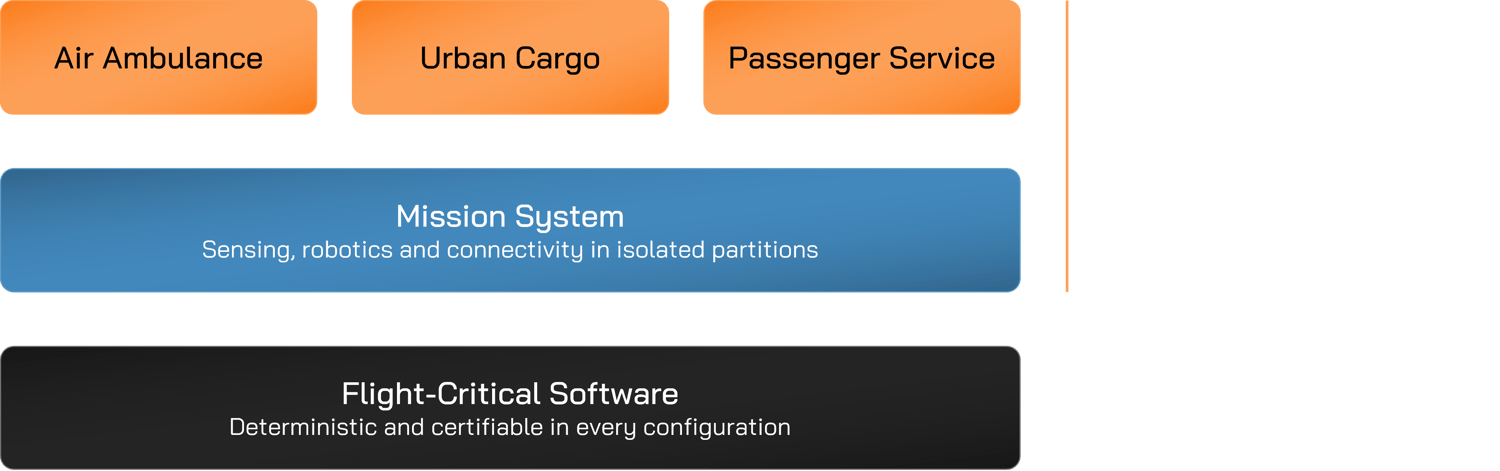
Figure 1. One airframe, one software architecture, three missions. Illustrative.
| Customer | An integrated avionics supplier developing systems for low-altitude and advanced air mobility aircraft |
| Industry | Advanced air mobility |
| Application | Distributed cockpit graphics with central compositing |
| Workloads | Lynx CoreSuite 2.0 |
| AI acceleration | Virtualized ARINC 653 multi-partition RTOS with an AMD Radeon Embedded E9171 GPU |
| Lynx products | LYNX MOSA.ic |
The Challenge
A modern cockpit combines content from many applications into a single picture. These applications often come from different teams and suppliers and are developed to different assurance levels: flight instruments and alerts sit at the top of the scale, while maps, video and maintenance pages sit lower. The supplier must merge all of them into one display without letting a fault in a lower-assurance application corrupt what the pilot relies on. The combined image must also stay timely and predictable, frame after frame.
The graphics layer adds a further question. When several partitions and more than one compositor share a GPU, the supplier needs a safety-critical driver stack and a way to show that the GPU is still drawing correctly.
The Solution
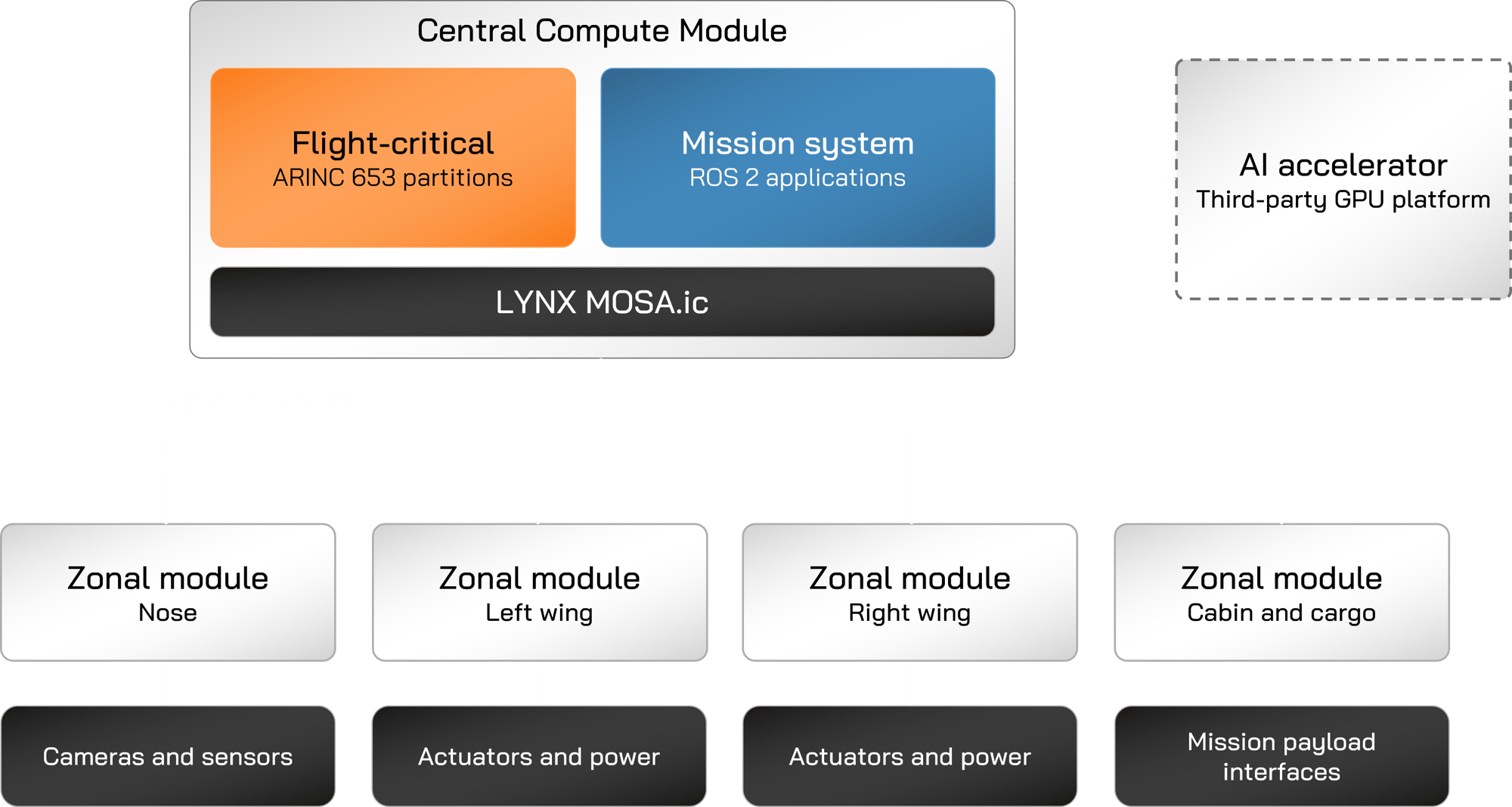
The customer runs each application in its own ARINC 653 partition and renders through OpenGL SC 2.0. Compositor partitions combine the content from the producing applications into the final display images, and the virtualization platform enforces spatial and temporal separation between partitions at different assurance levels.
Lynx CoreSuite 2.0 supplies the safety-critical GPU stack. Its OpenGL SC 2.0 libraries let every partition share the GPU, and its TrueCore safety monitor continuously checks the integrity of the GPU’s output.

Figure 2. Compositing across partitions on a shared GPU. Illustrative.
The Benefits
- One mission system for every role. The same software architecture serves the ambulance, cargo and passenger configurations.
- Familiar tools safely contained. ROS 2 applications run beside flight-critical software without sharing its fate.
- Less hardware to carry. Central and zonal modules replace many single-function computers.
- A clearer path to certification. The partitioned design keeps flight-critical evidence separate from mission software that changes more often.

LYNX MOSA.ic in This Solution
MOSA.ic is the mixed level of criticality Operating Environment, consisting of a separation kernel-based hypervisor type 1, enabling to rum different subjects with space and time partitioning enabling mixed level of criticality. MOSA.ic is DO178C DAL A certifiable.Questions to Ask When Designing Mixed-Criticality Graphics
- How do mission workloads reach sensors and the network without passing through flight-critical software?
- How is ROS 2 isolated from ARINC 653 partitions, and what evidence supports that separation?
- How do zonal modules share time and data with the central compute modules?
- How does the design add a third-party AI accelerator without widening the flight-critical certification boundary?
Seize the Edge™
Lynx builds trusted software platforms for commercial aerospace, defense and space. Its portfolio includes MOSA.ic.AI framework for mixed-criticality systems. Talk to a Lynx engineer about safety-critical graphics and mixed-criticality platforms for your cockpit.