
The latest release brings AI-assisted configuration, live in-mission reconfiguration, and new timing and networking flexibility to LynxElement and LynxSecure® — cutting the time and expertise it takes to move safety- and security-critical systems from prototype to deployment.
Two things slow down every safety-critical program: how long it takes to get a working system stood up, and how hard it is to change that system once it's fielded. MOSA.ic™ 2026.09 takes aim at both. This release pairs a genuinely new way to configure the platform — using AI — with a set of capabilities that make deployed systems more resilient and more adaptable in operation. The result is less time spent on plumbing and more spent on the mission.
Here's what's new, and what it means for your program.
AI-Assisted Configuration: Lower the Barrier, Accelerate the Prototype
The truth about any high-assurance integration platform is that configuration is where new teams lose time. The full MOSA.ic stack spans many configuration files and rewards deep product knowledge — knowledge that takes time to build and often bottlenecks on a few experienced engineers.
MOSA.ic 2026.09 changes that equation. The default LynxElement project now ships with workflows that let AI agents automatically generate MOSA.ic application configurations. Instead of hand-authoring the stack's configuration, teams can let an AI agent handle the bulk of that complexity — a more powerful alternative to the configuration wizard in Luminosity.
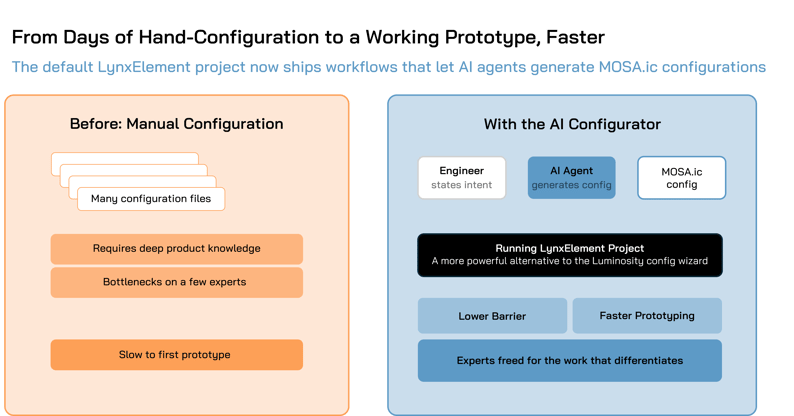
AI-assisted configuration takes on the complexity that used to bottleneck new teams — reaching a working LynxElement project faster.
For a program, the value shows up immediately. A new engineer can get to a working configuration without first mastering every detail of the platform, which lowers the barrier to entry and widens the pool of people who can be productive. Evaluations and rapid prototyping move faster, so you reach a demonstrable system — and a go/no-go decision — sooner. And your most experienced architects spend less time on boilerplate and more on the parts of the design that differentiate your product. In a market where schedule is often the scarcest resource, compressing the path from "new to the platform" to "running prototype" is real money saved.
Resilience in the Field: Warm Restart and Live Reconfiguration
Getting a system built is half the challenge; keeping it available and adaptable once deployed is the other half. On ARM hardware, LynxSecure now supports a software warm restart — the ability to reboot all LynxSecure virtual machines without a full hardware reset.
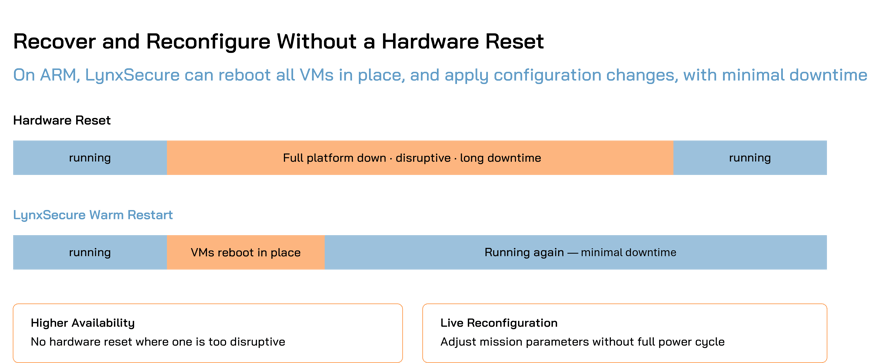
A warm restart recovers and reconfigures the system in place, where a full hardware reset would be too disruptive
That matters most exactly where a hardware reset is least acceptable. In a deployed or in-mission system, cycling the hardware can be disruptive, slow, or operationally risky. A warm restart lets the system recover and reconfigure in place, with far less downtime. Just as important, warm restart supports configuration changes — so teams can adjust mission parameters live, adapting the platform to a changing mission without taking it all the way down and back up. For fielded platforms that have to stay ready, that combination of faster recovery and in-place reconfiguration translates directly into higher availability and greater operational flexibility.
Precision Timing: Synchronize the Whole System to One Source
Complex platforms increasingly depend on many subsystems agreeing on time. In MOSA.ic 2026.09, the LynxElement scheduler can be driven by external clocks, so timing can come from a custom source such as an on-board timer rather than being confined to the processor's own clock.
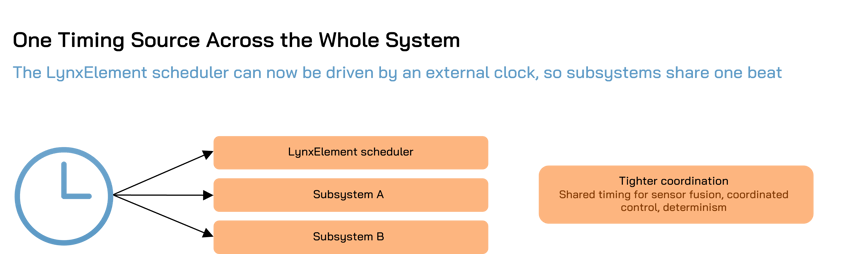
Driving the scheduler from an external clock lets multiple subsystems share a single timing source.
The benefit is system-wide coordination. Multiple subsystems can share a single timing source, which makes it far easier to keep distributed functions — sensor sampling, data fusion, coordinated control — aligned to the same beat. For integrators building platforms around a master clock or a precise external reference, this removes a common source of integration friction and tightens the determinism the whole system depends on.
Networking Flexibility, Without Giving Up Assurance
Networking is often where teams need to do something custom — a tunnel, a filter, a bespoke protocol — and historically that has meant a trade-off against a certified, trusted stack. MOSA.ic 2026.09 eases that tension. With new TUN and TAP device drivers, custom user code in a LynxElement application can now interact with the Lynx Certified Network Stack (LCS) at lower network layers (L2 and L3) than before.
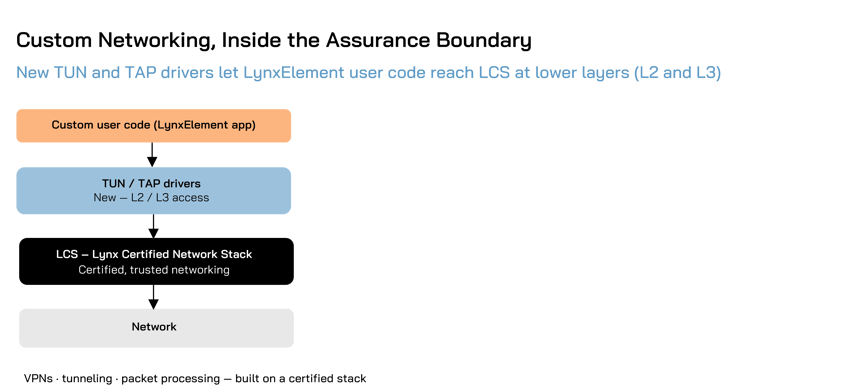
TUN and TAP drivers give custom user code lower-layer access to the certified network stack — without leaving the assurance boundary
Practically, that opens the door to custom networking features — VPNs, packet processing, tunneling, specialized protocols — built directly on top of a certified stack. Teams get the flexibility to address more use cases without stepping outside the assurance boundary that makes the platform certifiable in the first place. More of what you need to build stays inside the trusted environment.
A More Mature ARINC 653 Foundation
The previous release brought essential ARINC 653 conformances to LynxSecure and LynxElement. MOSA.ic 2026.09 refines that foundation with a range of stability and usability improvements. These aren't headline features so much as the kind of maturation that avionics teams feel every day — a smoother, more dependable path to integrating ARINC 653 applications, and one more sign that the platform is hardening for production programs.
The Bigger Picture
Every capability in 2026.09 serves the same goal: reduce the time, expertise, and risk it takes to build and sustain mission-critical systems. That builds on what MOSA.ic already brings to a program — LynxOS-178, a DO-178C DAL A certifiable RTOS with FAA Reusable Software Component status that helps customers reduce certification cost; LynxElement, the unikernel that reuses those DAL A artifacts for a smaller attack surface and simpler certification; and the LynxSecure separation kernel that consolidates mixed-criticality workloads onto a single multi-core processor to attack size, weight, power, and cost. Licensing is simpler too: Lynx products are no longer gated by a license manager.
What 2026.09 adds is momentum. AI-assisted configuration lowers the barrier to getting started. Warm restart and live reconfiguration keep fielded systems available and adaptable. External clock synchronization and lower-level networking give integrators the precision and flexibility real platforms demand. Faster to build, more resilient in the field — on an open, MOSA-aligned architecture designed to last the life of the program.
MOSA.ic 2026.09 is available now.
Talk to the Lynx team to see what it means for your platform, from first prototype to fielded mission.
Contact us here: https://www.lynx.com/contact-us.
Visit to learn more about LYNX MOSA.ic: https://www.lynx.com/solutions/lynxmosaic
Explore LynxSecure in our datasheet: https://www.lynx.com/resource-library/lynxsecure
Dive deeper into LynxElement in our datasheet: https://www.lynx.com/resource-library/lynxelement
MOSA.ic™, LynxSecure®, LynxElement®, and LynxOS-178 are trademarks of Lynx Software Technologies, Inc. FACE® is a registered trademark of The Open Group. Other brand or product names are trademarks of their respective holders. AI was used to assist in creating this blog.